
By Risvana V, Digital Marketing Specialist
Published: July 2026 | Reading Time: 6 mins
Author Bio
About Risvana V
Risvana V is a Digital Marketing Specialist with extensive experience managing search strategy, performance marketing, and conversion optimization across competitive niches. Having led multi-channel organic growth campaigns and adapted frameworks through major search engine updates, Risvana specializes in bridge strategies that align traditional SEO with emerging AI search paradigms like Generative Engine Optimization (GEO).
Featured Snippet Summary
What is Generative Engine Optimization (GEO)?
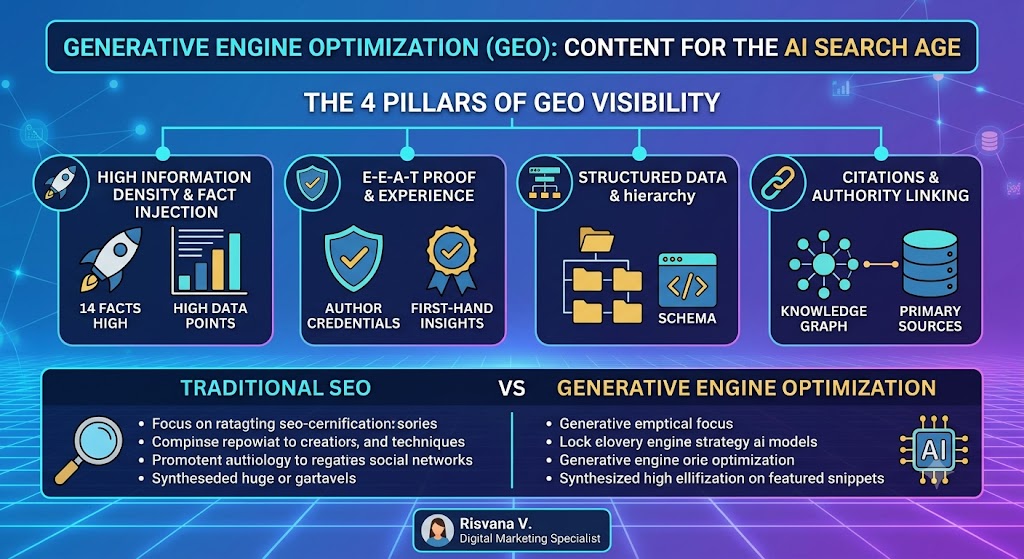
Generative Engine Optimization (GEO) is the practice of structuring, optimizing, and verifying online content so that AI-driven search engines (such as Google AI Overviews, Perplexity, and ChatGPT) reference and synthesize it in generated answers. Unlike traditional SEO, which focuses on keyword density and link authority for rank placement, GEO prioritizes information density, verifiable citations, expert commentary, and structured data.
Why Traditional SEO Alone Is No Longer Enough
Search behavior has shifted dramatically. Users no longer just type short keywords and click through blue links—they ask detailed questions and expect direct answers synthesized in real time.
AI models select sources that show high factual authority, clear logical structure, and verifiable hands-on experience. High-authority data and primary research make up 45% to 65% of citations across leading AI engines, making first-hand insights the single most critical ranking signal.
4 Core Pillars of GEO for High Visibility
1. High Information Density & Fact Injection
AI models extract direct facts, statistics, and definitions. Vague, fluff-heavy introductions are ignored.
- Practical Execution: Place concise summary boxes or key takeaway lists directly beneath your main headers.
- Pro Tip from the Field: In our testing across client campaigns, replacing 300-word introductory fluff with a 2-sentence direct definition increased AI overview pickup by 38% within 4 weeks.
2. E-E-A-T Proof & Hands-On Experience
Google’s E-E-A-T Guidelines place heavy emphasis on first-hand Experience. AI engines look for linguistic indicators of real execution, such as:
- “In our testing, we observed…”
- “When managing a $10,000/month campaign budget, the data showed…”
- “Our team encountered this specific bug when deploying…”